
When one side of the back rises as your child bends forward
Adolescent scoliosis by the numbers: how common it is, and when an evaluation is needed
 Sungjong Park, D.C. · October 2026 · Reading time 6 min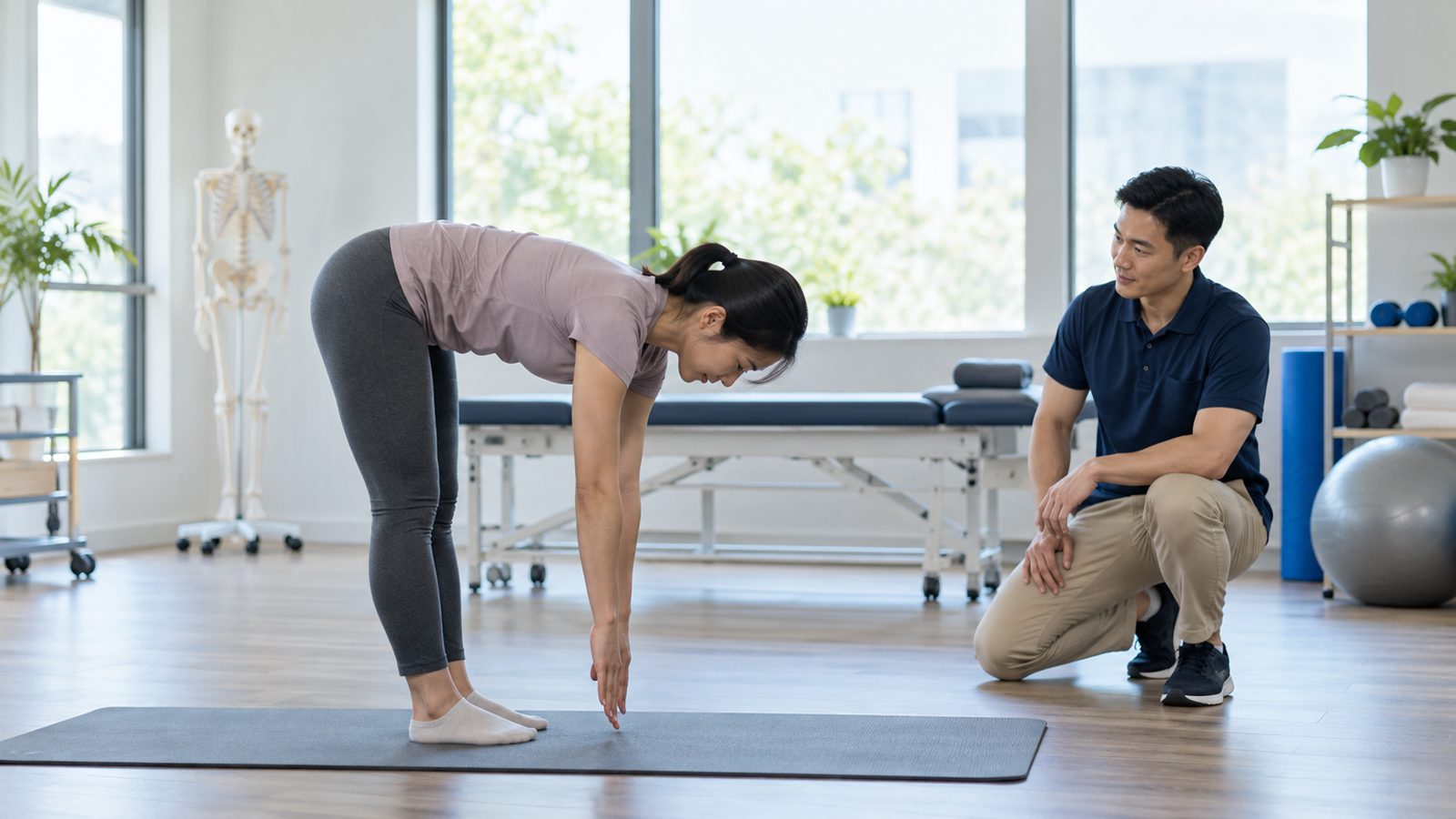
One to three in every 100 adolescents. That is the prevalence of adolescent idiopathic scoliosis summarized by the US Preventive Services Task Force (USPSTF) in its 2018 evidence review. It would not be unusual to find one in a single classroom. Because it usually doesn't hurt, family members tend to notice before the child does: while drying their back after a bath, or seeing them from behind in a swimsuit. Here is what to look for in that moment and which numbers to use as a guide. I have included only figures I checked in the original sources.
10 degrees, and 1–3%
Scoliosis is a sideways curve of the spine in which the vertebrae also rotate. It is defined by the angle of the curve measured on a standing X-ray, known as the Cobb angle. A curve must be 10 degrees or more to be called scoliosis. Nine degrees falls outside the diagnostic threshold.
Most scoliosis that appears in adolescence is "idiopathic," meaning no clear cause can be found. The USPSTF evidence review summarized the prevalence in 10- to 18-year-olds as 1–3%, and the screening studies included in the review ranged from 1.2% to 3.5%. A 2001 review in American Family Physician (AFP) gives 2–4% for ages 10 to 16. The range reflects differences in region and time period across studies. It is also worth noting that these figures are not specific to Korean or Vietnamese adolescents.
There are other numbers worth paying closer attention to. In the same AFP review, the prevalence of curves greater than 30 degrees is about 0.2%, and curves greater than 40 degrees about 0.1%. In other words, most curves that are found are small. The review notes that about 10% of diagnosed adolescents have curves that progress to the point of needing medical intervention. Common, but mostly staying small: it helps to keep both of these in mind.
How to check at home, and 5–7 degrees
Have your child stand in a relaxed position and look at them from behind. Check whether any of the following stand out.
Next is the forward bend. With feet together and knees straight, your child lets their arms hang down and bends forward slowly. When the back is nearly parallel to the floor, compare the height of the left and right sides from behind. If one side of the upper or lower back rises like a hump, it may be a sign that the vertebrae are rotated. It is not a diagnosis, but a sign that an evaluation is needed.
Practitioners turn the size of that hump into a number using a scoliometer, a tool that measures the tilt of the back. According to the USPSTF evidence review, the Scoliosis Research Society (SRS) recommends an X-ray referral when this reading is 5–7 degrees or more. Skaggs explains that 7 degrees corresponds roughly to a Cobb angle of 20 degrees. Thresholds vary somewhat between sources. A 2014 AFP review divides readings this way: under 5 degrees likely needs no follow-up, 5–9 degrees calls for a recheck in at least 6 months, and 10 degrees or more calls for confirmation by X-ray.
Not seeing anything at home is not a reason to relax just yet. In one study cited in the USPSTF review, the forward bend test alone detected scoliosis with a sensitivity of 84.4%. Small curves are easy to miss by eye.
- The shoulders are at different heights
- One shoulder blade sticks out more than the other
- The waistline (the curve of the sides) differs from left to right
- One side of the pelvis looks higher
Growth, angle, and sex
The factors that determine whether a curve will progress are fairly clear. Skaggs named the two most important as the size of the curve and the amount of growth remaining, and other reviews add sex to the list.
The effect of remaining growth becomes clear in the numbers. In 1984 data from Lonstein and Carlson, cited in the 2014 AFP review, among children at skeletal maturity stage (Risser grade, a measure of maturity based on the pelvic growth plate) 0–1, 22% of 5–19 degree curves and 68% of 20–29 degree curves progressed. For the same angles at Risser 2–4, the figures were 1.6% and 23%. Even at the same angle, the more growing a child has left, the greater the risk.
The difference between the sexes also depends on the angle. Small curves of around 10 degrees occur at similar rates in girls and boys. For curves over 30 degrees, however, the 2001 AFP review reports about 10 girls for every boy. The 2014 review puts it this way: girls are 5 to 10 times more likely to progress to a severe curve. If you have a daughter going through a growth spurt, making a habit of checking her back regularly can help.
What an evaluation looks at
An evaluation starts with a history. You will be asked when the curve was first noticed, about family history, and about growth milestones such as the first period or height gain. Next comes observation in standing and bending positions, and a scoliometer measurement of the tilt. From a chiropractic perspective, posture habits, movement, and left–right muscle balance are also assessed.
Whether to take an X-ray, and how to read it, is for a physician to decide. The images are used to check both the Cobb angle and the state of bone growth. Skaggs proposed curves over 20 degrees in a still-growing child, or over 40 degrees in an adolescent who has finished growing, as thresholds for considering referral to an orthopedic spine specialist. Whether a brace or surgery is needed is decided by the specialist based on the angle and growth stage.
One more point: in 2018, the USPSTF issued an "I statement," concluding that the evidence is insufficient to weigh the benefits and harms of screening all children aged 10 to 18 without symptoms. This applies to mass screening, such as at school. Children with a visible deformity are not covered by this recommendation. If you have noticed a sign at home, the next step is an evaluation.
See a doctor first if…
- The curve becomes noticeably larger over a short period during growth
- Back pain is severe, or pain wakes your child at night
- There are nerve symptoms such as leg numbness, weakness, or a change in walking
In these cases, see an orthopedic spine specialist first.
At the next bath time, ask your child to bend forward slowly. If one side seems to rise, take a photo of their back and bring it with you to an orthopedic evaluation.
This article is for general health information. Everyone's condition is different, so an accurate assessment requires consulting a professional.